An image from the film this blog is named after.

An image from the film this blog is named after.

Tuesday, May 12, 2020

BFI Top 50: City Lights, Released in 1931, Directed by Charlie Chaplin


What I know going in
The film is Charlie Chaplin’s last silent movie and was made during a time when sound film had essentially taken over. It is considered by many to be the last, great silent movie.

Immediate reaction
I think I watched this movie in the wrong setting (alone, around midnight, by myself) to truly appreciate it. While I did find the movie amusing, I never found it uproariously funny, which is odd because it is considered one of the greatest comedies of all time. I watched Buster Keaton’s Steamboat Bill Jr. in a theater, with a decent amount of people, and with live piano accompaniment. I highly enjoyed that movie and laughed out loud numerous times along with the audience. It is somewhat difficult for me to put myself in that kind of mood to appreciate silent film. If I had seen City Lights in a setting similar to the one I saw Steamboat Bill Jr. in, I may have found the film more enjoyable.

City Lights is the first Charlie Chaplin film I have seen and I kind of can’t believe that someone who looks like Chaplin even exists, let alone was allowed to become one the of biggest stars in the history of film. He is an incredibly tiny person, not only height, but also in overall mass (a fact which is used to great effect during the boxing scenes). Of course, he also flits about the city in his famous tramp outfit, which includes a bowler hat, a bamboo cane, tattered pants, and a suit coat. This bizarre combination of clothing gives Chaplin the appearance of a sophisticated hobo. His infamous mustache and painted-on eyebrows further contribute to Chaplin’s utterly bizarre appearance. 

The boxing scene is where the movie really picked up for me. Chaplin enters a boxing match to make money for his blind sweetheart. He has arranged the match beforehand with his opponent to where they will both go easy on each other and split the winnings 50/50. Unfortunately, his opponent is wanted by the police and has to bolt before the match. Chaplin is then matched up with a more imposing opponent. Chaplin attempts to flirt/seduce/charm in his opponent in one of the funnier scenes. I haven’t watched a whole lot of movies from this time period, but I did find it interesting that the film was essentially making gay jokes. I don’t know if other films from this period used similar humor. If not, I do have to give the film points for willing to go there. This of course leads, to the funniest scene in the movie, Chaplin’s boxing match. The match becomes some type of weird, comic ballet. The ref stands between the two boxers as they circle around each other, Chaplin flails about grabbing onto anything he can, and the two boxers get up and then fall back down several times.

I also found the ending to be very movie, and I was even a bit surprised that ended on a somewhat ambiguous note. Chaplin, completely dejected at this point, bumps into the blind woman whose eye surgery he paid for. Initially, she makes fun of him, but soon realizes that he was her past suitor. She then states “Yes, I can see know.” The film ends with Chaplin smiling down at her. It has been called one of the greatest and most moving ending in movie history, and I completely agree.

Further thoughts
The film also works perfectly as a social satire. It was released in 1931, during the great depression. It was probably very reassuring to audiences that the millionaire character was depressed, suicidal, and alcoholic. The millionaire only enjoys being around The Tramp when he is drunk. He is able to see past the exterior of The Tramp’s situation and actually enjoys spending time with him. When he is sober, he looks down on the Tramp just like everyone else. The Tramp and the blind girl, while both struggling to get by, are spiritually fulfilled. The girl’s blindness allows her to judge people on their actions, not on their appearance. This leads to her reacceptance of the Tramp when they meet outside her flower shop.

The film also portrays city life as manic and chaotic. This can be seen in Chaplin’s performance as he flails wildly about trying to come up with money for the girl. He rushes from being a street cleaner during a parade of horses and elephants to participating in an underground boxing match. Each character in the boxing scene probably has their own sad story for how they ended up there. Chaplin is able to engage with the crushing reality of the time and keep the film comic and sweet.

Why is it on the list?
Like I mentioned earlier, the films works as a social satire. I also can’t think of many other films, outside of Chaplin’s, that not only positively portray the homeless, but have one as their central character. As the last great silent film, it also signaled the end of era. Since I have not seen any of Chaplin’s other films, I can’t comment on how this one holds in comparison to the others.

BFI Top 50: Ugetsu Monogatari, Released in 1953, Directed by Kenji Mizoguchi


What I know going in
I know the film mainly consists of still photographs with voiceover, with one scene being a notable exception. I have listened to people talk about the film, so I know it has to do with the slippery nature of memory and time travel. I also know that the film was the inspiration for 12 Monkeys, directed by Terry Gilliam and also involving time travel to stop a viral outbreak. The film is considered one the landmark works of French New Wave, and this will be the first FNW film I have seen. I am not really sure how the odd composition of the film will work, but I am excited to find out.

My immediate reaction
Well… that was totally unlike anything I have seen before. I will give the movie, I have never seen a movie remotely resembling this, and I don’t think I ever will. I’m not even sure if this is a movie, or maybe it’s the most filmic of any movie ever. Technically speaking, a movie is a continuous stream of pictures that are designed to give the illusion of movement, a moving picture if you will. Although the movie is a series of still photographs, it is still able to effectively convey what is going on. The movie begins with the destruction of the world, which is conveyed through picture of a destroyed Paris during World War II. This is already suggestive of the recursive nature of the film’s narrative. As we will see at the end of the film, what has been observed once will happen again. The narrator then speaks of a child who has the image of a beautiful woman and a man dying burned into his brain. This image is so strong that the protagonist is used by a shadowy group, who only speaks German (maybe implying that they are responsible for the war?), to travel back in time. The protagonist then begins slip through time and repeatedly encounters the same woman over and over again.

Here is where the message of the movie began to gel for me. The protagonist appears to be unable to stay with the woman from the past. To me, this represents the frustration of relying on memory to recall past events. Once we stop experiencing a certain moment, we can no longer come back to it, and only the most significant, powerful, and important events of our lives have any hope of being recalled. But, even these powerful moments can be distorted as we forget the tiny details. Ultimately, the protagonist is able to return to the memory of his childhood, but is killed by his captors, completing the image from his childhood. He is essentially punished for trying to live in the past. Try as we might, we can never return the past, whether that be through time travel or through our own memories, what’s done is done and it can never be returned to.

Further thoughts
The procession of still images and the voiceover narration give the movie an almost documentary-like feel. Like this footage has been sent back time to warn us about what may come to pass if we continue in our current direction.

I’m going to be honest here; I have found a lot of the film to be impenetrable beyond my initial thoughts. Reading other analyses has not really helped that much. It has pointed out that the film was made around the time of the Cuban Missile Crisis, and of course during the Cold War. This does give the film some extra heft as a warning about what will happen if the nuclear arms race is allowed to continue. Humans may become just like the animals seen in the museum, lifeless and on display.

I have not yet mentioned the brief scene of actual movement in the film. During a montage of the girl waking up, she briefly blinks her eyes. For one brief moment, we can truly experience the beauty of this moment. This reveals the true power of film, through film and beyond our own memory, we can reshape the past and achieve some type of truth, even if it incredibly brief.

Why is it on the list?
Like I said earlier, the film is defiantly unlike anything else I have seen. It examines the nature of memory, the power of film, the cycle of time, and the implications of the Cold War. That it does all of these in less than 30 minutes and without most of tools cinema makes use of, makes it inclusion easily defendable.

BFI Top 50: La Jetée, Released in 1962, Directed by Chris Marker

What I know going in
I know the film mainly consists of still photographs with voiceover, with one scene being a notable exception. I have listened to people talk about the film, so I know it has to do with the slippery nature of memory and time travel. I also know that the film was the inspiration for 12 Monkeys, directed by Terry Gilliam and also involving time travel to stop a viral outbreak. The film is considered one the landmark works of French New Wave, and this will be the first FNW film I have seen. I am not really sure how the odd composition of the film will work, but I am excited to find out.

My immediate reaction
Well… that was totally unlike anything I have seen before. I will give the movie, I have never seen a movie remotely resembling this, and I don’t think I ever will. I’m not even sure if this is a movie, or maybe it’s the most filmic of any movie ever. Technically speaking, a movie is a continuous stream of pictures that are designed to give the illusion of movement, a moving picture if you will. Although the movie is a series of still photographs, it is still able to effectively convey what is going on. The movie begins with the destruction of the world, which is conveyed through picture of a destroyed Paris during World War II. This is already suggestive of the recursive nature of the film’s narrative. As we will see at the end of the film, what has been observed once will happen again. The narrator then speaks of a child who has the image of a beautiful woman and a man dying burned into his brain. This image is so strong that the protagonist is used by a shadowy group, who only speaks German (maybe implying that they are responsible for the war?), to travel back in time. The protagonist then begins slip through time and repeatedly encounters the same woman over and over again.

Here is where the message of the movie began to gel for me. The protagonist appears to be unable to stay with the woman from the past. To me, this represents the frustration of relying on memory to recall past events. Once we stop experiencing a certain moment, we can no longer come back to it, and only the most significant, powerful, and important events of our lives have any hope of being recalled. But, even these powerful moments can be distorted as we forget the tiny details. Ultimately, the protagonist is able to return to the memory of his childhood, but is killed by his captors, completing the image from his childhood. He is essentially punished for trying to live in the past. Try as we might, we can never return the past, whether that be through time travel or through our own memories, what’s done is done and it can never be returned to.

Further thoughts
The procession of still images and the voiceover narration give the movie an almost documentary-like feel. Like this footage has been sent back time to warn us about what may come to pass if we continue in our current direction.

I’m going to be honest here; I have found a lot of the film to be impenetrable beyond my initial thoughts. Reading other analyses has not really helped that much. It has pointed out that the film was made around the time of the Cuban Missile Crisis, and of course during the Cold War. This does give the film some extra heft as a warning about what will happen if the nuclear arms race is allowed to continue. Humans may become just like the animals seen in the museum, lifeless and on display.

I have not yet mentioned the brief scene of actual movement in the film. During a montage of the girl waking up, she briefly blinks her eyes. For one brief moment, we can truly experience the beauty of this moment. This reveals the true power of film, through film and beyond our own memory, we can reshape the past and achieve some type of truth, even if it incredibly brief.

Why is it on the list?
Like I said earlier, the film is defiantly unlike anything else I have seen. It examines the nature of memory, the power of film, the cycle of time, and the implications of the Cold War. That it does all of these in less than 30 minutes and without most of tools cinema makes use of, makes it inclusion easily defendable.

Wednesday, April 22, 2020

BFI Top 50: Vertigo


Vertigo, Released in 1958, Directed by Alfred Hitchcock

What I know going in
I have seen the film twice before and look forward to seeing it again.

Immediate reaction
Vertigo has a lot in common with The Searchers. Both were made by established Hollywood directors at the height of their powers, on the surface both seem like straightforward entries in the director’s output, and both feature lead performance by icons. Finally, also like The Searchers, Vertigo has a dark heart that subverts what is ostensibly a typical mystery film and plants the seeds for various ideas that would become major preoccupations of the New Hollywood Era.

Things start off pretty normally. John “Scotty” Ferguson (Jimmy Stewart) is introduced chasing a criminal across a series of San Francisco rooftops along with his partner. Scotty slips, inducing the titular affliction, and his partner falls to his death trying to save him. Cut to a few months later and Scotty is almost fully healed and hanging out with ex-fiancée, current friend Midge, who drops a few hints that she has mixed feeling about their current relationship status. Scotty then gets a call from old college buddy Gavin Elster, who asks Scotty to follow and observe his wife (Madeleine Elster) and insinuates that she is haunted by the ghost of grandmother, Carlotta Valdes. This scene foreshadows one of the main themes of the film, men fucking over and controlling women, when Gavin reminisces about the San Francisco, and sets up that Scotty’s personality is going to get the best of him. He lightly protests when Gavin asks this of him, saying he’s retired, but you can see a hungry glimmer in Stewart’s eyes that reveals he’s too intrigued to say no to this opportunity.

Eventually, Scotty begins tracking Madeline and everything he sees seems to support Gavin’s supernatural explanation. Scotty follows her to the San Francisco Bay and rescues her after she falls (or JUMPS!) in. The two quickly become romantically entwined after a ghostly walk through the redwood forest and strange/passionate scene where Madeline confesses her fears of committing suicide and falls into Scotty’s arms as ocean waves crash behind them (a nice, overtly sexual touch if you ask me). Again, there is nothing incredibly weird at this point in the film. By that point in Hollywood history there had been plenty of films about private eyes getting wrapped in something too big and plenty of tales of infidelity. There is some nice ambiguity about whether or not Madeline is truly haunted or simply mad, but even if Vertigo suddenly turned into a ghost story, it would only be original or off-beat because it combined two different genres. What makes Vertigo a weird, psychologically disturbing film will come later on.

Things come to a head when Scotty takes Madeline to an old Mission that she has described from a dream she had. She freaks out and seems to recall events that Carlotta witnessed, runs up into the belfry, and throws herself off the ledge, while Scotty looks on in horror, unable to do anything because of his vertigo. The film could probably end after Madeline’s death without being totally unsatisfying. It would be a pretty standard tale of an ex-cop getting involved a torrid romance that ends in tragedy, but it would still be a functional film. However, if Vertigo ended here, it wouldn’t be the masterpiece we know today.

After Madeline’s death, Scotty finds himself under investigation for what happened. He is freed of all guilt, but only after the top officer gets in a few snipes about his illness and his relationship with Madeline. This is where the film’s diptych-like structure starts. Scotty finds himself haunted by thoughts of Madeline (much like Madeline was supposedly haunted by the ghost of Carlotta), and visits the exact same sites seen earlier in the film while he was tracking her. The film then drops in one of the earliest examples of an attempt at visually representing a hallucination or nightmare. I don’t think the effect wholly works to day, but it is interesting precursor to the trip-like effects in 2001 and Altered States. Scotty’s nightmare is, for me, the exact point where Vertigo becomes something unique and frightening. Scotty falls into a deep depression, again mirroring Madeline’s madness, which he eventually overcomes in a few months’ time. Scotty then randomly bumps into a girl who looks exactly like Madline, Judy. She is introduced wearing green, much like Madeline (another element of the film referencing itself). Scotty follows her up to her room and convinces her to go dinner with him.

This is when we get to the meat of the film. In a process that not only mirrors how Gavin must have molded Judy, but also has an eerie resemblance to the way directors mold actresses, Scotty slowly, but surely forces Judy to change her appearance. This includes getting her the exact right apparel, dying her hair platinum blond, and forcing her to pin it up in exactly the same shape as Madeline. This transformation culminates in one of the greatest scenes in all of cinema history. Judy steps out, and the light hits her in just the right way so that she looks like a ghost. She and Scotty embrace, drenched in green light, as the camera twirls marvelously around them.  It also works as a callback to Scotty and Madeline’s embrace by the ocean edge. I have no idea how the latter part of the film played during its initial release. Stewart totally foregoes his typical nice guy persona and acts like a controlling dick. Furthermore, there is a hugely uncomfortable layer to these scenes when you consider Hitchcock’s obsession with blonde it girls. I’m very interesting in learning what he thought of the film. In addition, Madeline keeps laying these hints that what Scotty is doing is crossing some terrible, metaphysical line.

-        Judy: If you change me, will that do it? If I do what you tell me, will you love me?
-        Scotty Yes. Yes.
-        All right. All right then, I’ll do it. I don’t care anymore about me.

-        Judy: Couldn't you like me, just me the way I am? When we first started out, it was so good; w-we had fun. And... and then you started in on the clothes. Well, I'll wear the darn clothes if you want me to, if, if you'll just, just like me.
-        Scotty: The color of your hair…
-        Judy: Oh, no!
-        Scotty: Judy, please, it can’t matter to you.

With these scenes, Vertigo also becomes a film about films. Scotty becomes obsessed with recreating Madeline. He becomes obsessed with someone who wasn’t real. He becomes obsessed with his image of that person. This is the subversive heart of Vertigo, that no matter how much we want a fantasy, an image, an idea, or a film to be real, it simply can’t, and to attempt otherwise is to court tragedy. Scotty’s obsession with the unreal leads to Judy’s death and the final piece in completing the film’s doomed diptych.

Random notes:
-        I saw a lot of Mad Men in this rewatch of Vertigo. The famous opening of a black outline falling is directly taken from a similar design in Scotty’s nightmare. And one of the main themes of the show is the rampant sexism of the era, which Vertigo deals with through Gavin and Scotty’s dickish manipulation of Judy. Vertigo also has two characters (Gavin and the book-store owner) lament the fact that women can’t be tossed aside as easily as they used it.
-        I wouldn’t classify Vertigo as a noir, but it makes good use of the sun-dappled exteriors of San Francisco nearly two decades before Chinatown made sunny L.A. seem like the most dangerous place on earth. And, much like how Chinatown attempts to grapple with the dark, secret history of L.A., Vertigo, with the story of Carlotta, delves into some of San Fran’s hidden past.
-        A much later film, Mulholland Drive, owes a debt to Vertigo as well. That film’s themes of duality and shifting identity seem directly inspired by Hitchcock’s uncomfortable masterpiece.

Further thoughts
One thing I forgot to mention in my original piece was the backstory I imagined for Judy. We don’t really learn about her history, except that she is from Salina, Kansas. Solid information about her relation to Elster isn’t give either. It’s implied that she was his mistress and decided to help him in his murderous quest due to money and a power imbalance. The backstory I came up with involved Judy as naïve Kansas girl, hoping to go west to Hollywood and break it big on the silver screen! Once she gets there though, she can’t catch a break, and, on her last dime, is contacted by Elster for a shadowy job. With no other way to make money of her acting talent, she takes the job which launches her on her doomed collision with Scotty. I don’t know why I thought this up, except that it fits with the film’s twisted relation to Hollywood filmmaking.
An aspect of the film I came to appreciate after reading through some of the reviews was its second act change in perspective. During the first part of the film, the camera is very focused on Scotty. It even literally adopts his point of view several times, as can be seen in the sequences of him driving around and tailing Madeline and her iconic introduction at Ernie’s. After Madeline’s “death” however, there’s a switch in focus. After Scotty leaves Judy’s apartment, the camera doesn’t follow him out the door, it stays with her (something that has only happened 2 or 3 times throughout the film at this point). The film then reveals its big mystery by having Judy flashback, write a letter, and perform a voiceover narration. This is an incredibly important scene in the film. Both Robert Cumbow (Parallax View) and Brian Eggert (Deep Focus Review) mention how this scene shifts audience sympathy away from Scotty and onto Judy, and, as Hitchcock himself described, it turns standard surprise into suspense. The letter scene shifts the question from “What will the twist be?” to “What will Scotty do once he finds out Judy’s secret?”

Why is the film on this list?
It’s ironic that the top film on this cinephile list is a warning sign to film fans not to become to obsessed with their favorite art form, lest they find themselves looking into the abyss of unreality like Scotty in Vertigo.

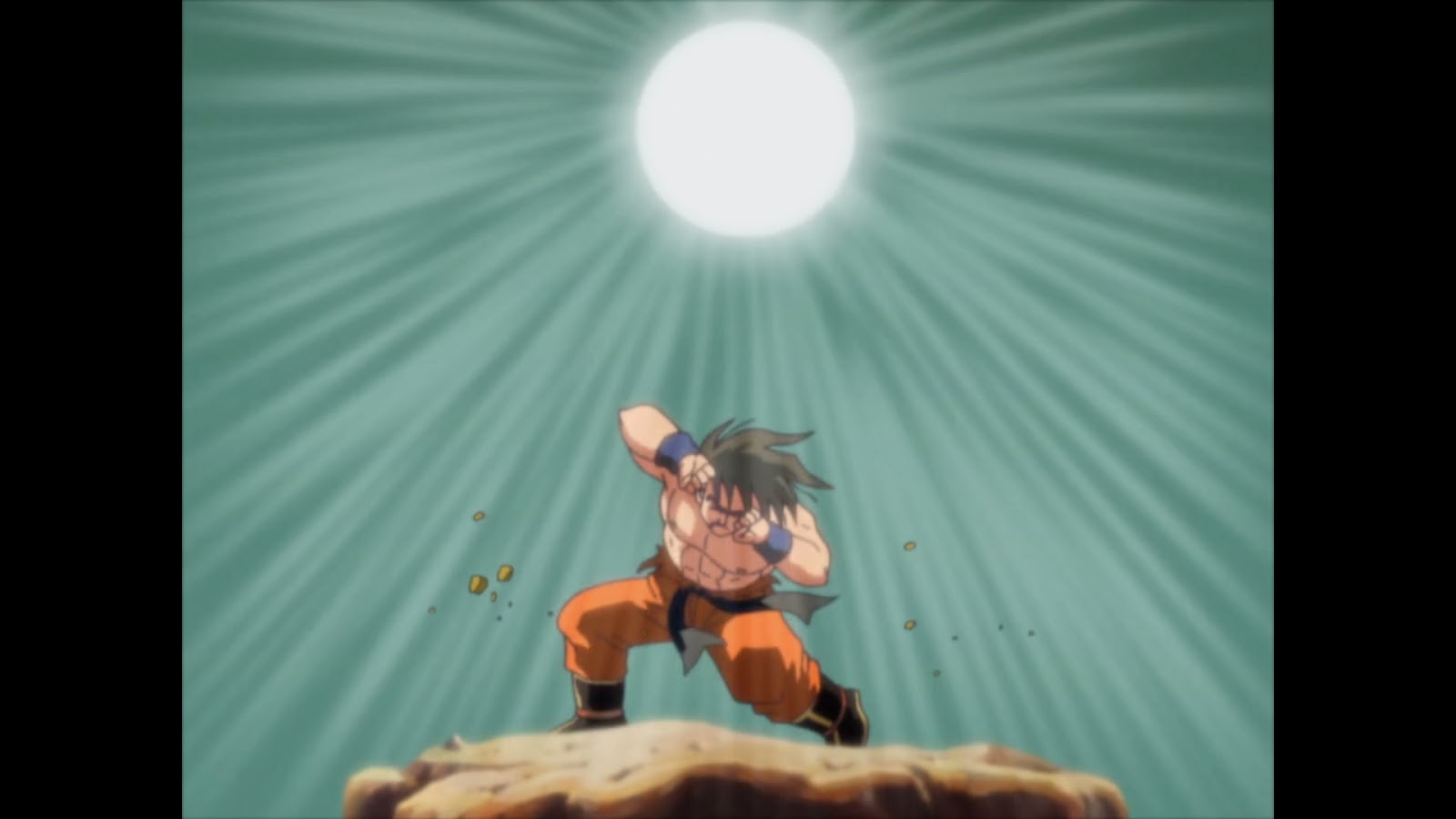
Action Shots: Dragon Ball Z Kai

Some cool images from Vegeta and Goku's first fight in Dragon Ball Z Kai. Roughly episodes 15-18. Re-watching this sequence recently, it has become fairly clear that this is the best fight in the series. Vegeta and Goku use a wide variety of powers and strategies. The characters all look like they take a beating. And every character, not just Goku, actually does something meaningful throughout the fight. The direction is also better than the rest of the series. There's a good mix long-shots, mid-range shot, and close-ups. The use of close-ups is especially effective when it's used to emphasize the character's pain. Vegeta is spitting and coughing blood, and Goku's use of Kaio-Ken is animated in a way that makes it look physically painful for him. The re-dubbing is also aces. Vegeta is appropriately evil and arrogant. Goku projects his usual calm self. The arc is also completed in a few episodes. The later fights in the series quickly devolve into very bland, samey direction, and the fighting becomes more rote and less dynamic.

Below are some of the more striking images from this sequence. I wouldn't say I could find single, punchy images like these in later episodes: 

Saturday, January 28, 2017

Short Reviews of Three Books

Gustav Klimt: Art Nouveau Visionary by Eva di Stefano

I had never heard of Klimt or seen any of his work, until I randomly picked up this book while perusing through Barnes and Noble's art section one day. I was immediately struck by the cover, and the few other paintings I saw as I flipped through the book, and ended up purchasing it on a whim.

Needless to say, I'm extremely glad I picked it up, discovering one of my new favoriate artists in the process. Kudos to Stefano for laying out all of Klimt's major works, and some choice selections from those of his contemporaries, in an attractive manner. She also expertly explains Klimt's process, his general thoughts about art, and the social background of turn-of-the-century Vienna.

Klimt's style is a beauty to behold. His mix of decorative arts, geometric patterns, and semi-flat perspective create twisty, spiraling phantom-like figures that seem to spring out of nowhere and never end. As you study them and try to discern their different parts, they invoke a feeling of optical illusion.

His work with female faces and figures is sensuous, erotic, and scandalous even now. I don't know if you could appropriately call his artwork feminist, but it presents female pleasure and authority in such an upfront, positive way (completely free of judgement or misogyny) that it's quite shocking and revelatory to look at. Even more so, considering he lived 100+ years ago.


Dune by Frank Herbert 

Reading Dune is like panning for gold. The gold in this case being Herbert's detailed, poetic descriptions of the ecology and environment of Arrakis, and the structure and functioning of the Fremen. Mainly because these aspects seem the most most thought-out.

Unfortunately much sifting is required when slogging the rest of the novel. The aforementioned elements are only one part of the story and don't fully bloom until halfway through a 400 page book. The rest is given over to a standard chosen one narrative with a warring feudal families background that will be familiar to anyone who has existed for a few years on this Earth.

The problems with the book are compounded by the terms and mythology Herbert invented. Much of the created vocab sounds and usually has a real-life analog that could've been easily slotted into a sci-fi setting. The philosophical and religious elements that are not part of the Fremen add little. It's rote new-age, semi-eastern stuff that again will not surprise anyone reading today.

Also troubling is Herbert's refusal to develop any kind of critique of the obviously brutal, oppressive society that Paul and his family inhabit. The closest he gets is contrasting the decadence of the Imperium with the asceticism of the Fremen. But this comparison does not involve any kind of difference in how authoritarian each society is or ends up being.

One could easily imagine an alternative, streamlined Dune that ditches much of the extraneous bits that drag the story down and instead focuses on the Fremen in an anti-colonial resistance to the empire. This would keep what is interesting and original in the novel without the garbled prose and unsettling politics.


Confronting Fascism by Don Hamerquist, J. Sakai, and Others


Confronting Fascism has some important insights into the nature of the most deadly of isms. Mainly that it is possible for fascism to develop into a popular, mass movement rooted in the lower and middle classes that is entirely autonomous from the ruling class. This point is echoed in two other books I recently finished: David Renton's Fascism: Theory and Practiceand Robert Paxton's The Anatomy of Fascism.

Renton describes fascism as a form of reactionary mass politics and Paxton does a deep dive into the early stages of the development of fascist parties. Paxton's book is the most useful as it gives a blow-by-blow account of how fascism began as a vaguely revolutionary movement started by an eclectic mix of artists, intellectuals, ex-leftists, and decommissioned soldiers; took root by physically confronting working class organizations; and ultimately came to power by a combination of incompetence, inertia, and cynical plotting among the traditional elite.

Paxton's account is extraordinarily rigorous and also provides a brief overview of the conditions that made fascism attractive to people (world war, depression, the beginnings of mass democracy, a strong left). This separates it from the other two books. Confronting does not provide nearly enough evidence for its claims and twice dips into conspiracy theories. Meanwhile, Theory and Practice is too heavy on the former and too light on the latter. It's more accurately a collection of how different thinkers have defined fascism. But all three reach the same, important conclusion: that fascism is a specific danger outside the normal functioning of society that has to be stopped before it can take power.

Thursday, January 12, 2017

Review: Mad Max Fury Road

Directed by George Miller
Written by George Miller, Brendan McCarthy, and Nick Lathouris
Starring Tom Hardy (Max Rockatansky), Charlize Theron (Imperator Furiosa), and Nicholas Hoult (Nux)
Cinematography by John Seale
Edited by Margaret Sixel
Music by Junkie XL

In a pleasant surprise, George Miller's heavy-metal extravaganza, Mad Max: Fury Road, was nominated for ten Oscars. I say surprising because the Academy Awards rarely recognizes artistry and brilliance when they are contained in genre works (action, horror, thriller). Six of these nods were part of the technical categories, which sometime serve as the space to honor more off-beat choices, but four were in the major groupings. These included Best Picture, Best Director, Best Cinematography, and Best Film Editing. Fury Road ended up winning five, and Margaret Sixel took home the most notable, receiving a gold statuette for her editing work. In a truly just world the movie would have won everything it had been put up for, and decorated Tom Hardy and Charlize Theron for their duo of committed, over-the-edge performances. Alas, gearheads aren't in control in of the Academy of Motion Picture Arts and Sciences (at least not yet), so we'll have to make do with what is hopefully an initial salvo directed against the stuffiness of the Oscars.

Onto the meat of thing, the third sequel featuring our titular car cowboy, this one opens with a should-be-by-now iconic opening shot of Max, newly enveloped by an unruly mass of hair, standing over a bleach-out desert,V8 interceptor by his side. Shaking off encroaching madness, he is soon chased down and captured by a gang of vehicular bandits. From there, the creative team quickly establishes the vast chasm that separates the world of this entry to the others in the series. If the original Mad Max depicted an Australia that was just starting to fray due to over-dependence on fossil fuels, and The Road Warrior showed the immediate aftermath of societal collapse, then Fury Road leaps forward to a time where normality, security, cooperation, and abundance are hazy, near-forgotten memories or legends. There's little that's recognizable to us, and whatever detritus can be traced back to the current era is totally re-contextualized.
However, unlike 99% of blockbusters, the full details of this frightening new world are revealed in an organic way, mainly through character interactions, small-talk, and the robust, fully-realized production design. The audience is trusted to use their imagination to stitch the hints and suggestions together into a coherent whole. The first act feels like being suddenly (and violently) dumped into an ice bath as we watch Max get "processed" by his captors and are treated to a grand tour of the guts and bolts of Immortan Joe's medieval wasteland kingdom. His army of war boys, the hybrid norse-metalhead-biker religion he's built around himself, and the half-understandable slang that's arisen from the ashes of the English language are all introduced in short order. Again, all of these components are introduced through methods that make sense within the universe of the film. I never got the impression that the actors were speaking for the benefit of the audience. The way we are allowed to just sit back and absorb the novel aspects of Miller's vision is supremely refreshing in an age where most other movies of this kind are choked by garbled, expository dialogue.

After the overview of Joe's rule, the real action starts up as one of his high-ranking warriors, Imperator Furiosa, sets off in the War Rig on an errand run to pick up more "guzzoline". Secretly however, she has absconded with Immortan's four wives and is attempting to escape his grasp once-and-for-all. Upon uncovering Furiosa's back-stab, Joe summons the war-boys and a fleet of pursuit vehicles. Max is in tow as the "blood bag" for Nux. From there on, the ground work is laid for the expertly-choreographed chase that will take up the rest of the runtime and the basic ideas that will be explored. Using that scenario the crew behind and in front of the cameras masterfully shames all other filmmaking currently being done in this mold. All the problems associated with modern big-budget pictures (incomprehensible action, regressive gender roles, muddled or right-leaning politics) are avoided, and in their place is exhilarating combat, eye-popping backgrounds, and one of the finest female performances of the decade.